Amanda Golden
  • Home
  • Teaching
    • African American Literature from the Harlem Renaissance to the Digital Present
    • Digital Woolf
    • Victorian Technology and Art
    • Global Digital Modernisms
    • FCWR 101: College in the Digital World
    • ICLT 331: Women, Technology, and Art
    • FCWR 101: Apple and Microsoft: 1975 to the Present
    • FCWR 151: Writing New York
    • ICLT 330 Global Literature and Digital Culture
    • Reading New York
  • Research
    • Annotating Modernism: Marginalia and Pedagogy from Virginia Woolf to the Confessional Poets
    • The Bloomsbury Handbook to Sylvia Plath
    • This Business of Words: Reassessing Anne Sexton
    • Sylvia Plath Map of Northampton
    • Sylvia Plath's Library
  • Curriculum Vitae
  • News and Events
  • New Page

Archival Expedition: Midcentury Poetics at Emory University

12/8/2013

0 Comments

 
Picture
Archival Expedition: Part 1

Posted April 15, 2011

By Dr. Amanda Golden, Post-Doctoral Fellow in Poetics at the Bill and Carol Fox Center for Humanistic Inquiry

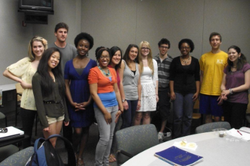
During the Spring 2011 semester, students in Dr. Golden's class completed a paper assignment using MARBL collections. Here, in a series of three blog posts, she talks about the experience she and her students had teaching from and researching in MARBL.

As the Post-Doctoral Fellow in Poetics at the Bill and Carol Fox Center for Humanistic Inquiry, I have had the opportunity to study Emory’s archival resources this year. This term in my Midcentury Poetics course (American Studies 385, cross listed as English 389 and Women’s Studies 385) we have been analyzing poetic expression following the Second World War. In class, we have analyzed several different types of primary sources—including periodicals, material from writers’ journals, correspondence, and manuscripts—in order to interpret poets’ responses to and roles in shaping midcentury academic and artistic culture. I began the term, for instance, with my images of Sylvia Plath’s annotated copy of T. S. Eliot’s The Waste Land (1922) in order to introduce the difficulty of modernism and post-war poets’ response to it. (Sylvia Plath’s copy of T. S. Eliot’s Complete Poetry and Plays is in the Mortimer Rare Book Room at Smith College.) We also discussed facsimiles of Sylvia Plath’s manuscript drafts of her Ariel (1965) poems housed in Smith College’s Mortimer Rare Book Room, Robert Lowell’s manuscript drafts, which are in Harvard University’s Houghton Library, and examples from Anne Sexton’s teaching notes for a course on her own poetry at Colgate University (1972).

Read the rest of Part I on Emory University's Woodruff Library Blog.  See also Part II and Part III.

0 Comments

Your comment will be posted after it is approved.


Leave a Reply.

    Picture

    Categories

    All
    African American Literature
    Anne Sexton
    Digital Humanities
    Digital Pedagogy
    Ezra Pound
    Harlem Renaissance
    James Joyce
    John Berryman
    Marginalia
    Modernism
    Northampton
    Pearl Cleage
    Ransom Center
    Smith College
    Sylvia Plath
    Ted Hughes
    Virginia Woolf

    Tweets by @plathpoem
Proudly powered by Weebly
  • Home
  • Teaching
    • African American Literature from the Harlem Renaissance to the Digital Present
    • Digital Woolf
    • Victorian Technology and Art
    • Global Digital Modernisms
    • FCWR 101: College in the Digital World
    • ICLT 331: Women, Technology, and Art
    • FCWR 101: Apple and Microsoft: 1975 to the Present
    • FCWR 151: Writing New York
    • ICLT 330 Global Literature and Digital Culture
    • Reading New York
  • Research
    • Annotating Modernism: Marginalia and Pedagogy from Virginia Woolf to the Confessional Poets
    • The Bloomsbury Handbook to Sylvia Plath
    • This Business of Words: Reassessing Anne Sexton
    • Sylvia Plath Map of Northampton
    • Sylvia Plath's Library
  • Curriculum Vitae
  • News and Events
  • New Page