Amanda Golden
  • Home
  • Teaching
    • African American Literature from the Harlem Renaissance to the Digital Present
    • Digital Woolf
    • Victorian Technology and Art
    • Global Digital Modernisms
    • FCWR 101: College in the Digital World
    • ICLT 331: Women, Technology, and Art
    • FCWR 101: Apple and Microsoft: 1975 to the Present
    • FCWR 151: Writing New York
    • ICLT 330 Global Literature and Digital Culture
    • Reading New York
  • Research
    • Annotating Modernism: Marginalia and Pedagogy from Virginia Woolf to the Confessional Poets
    • The Bloomsbury Handbook to Sylvia Plath
    • This Business of Words: Reassessing Anne Sexton
    • Sylvia Plath Map of Northampton
    • Sylvia Plath's Library
  • Curriculum Vitae
  • News and Events

Review of The Boundaries of the Literary Archive in Woolf Studies Annual 20 (2014)

3/10/2014

0 Comments

 
Picture
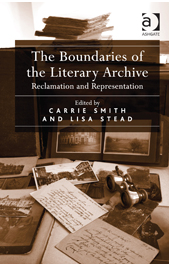
I have reviewed Carrie Smith and Lisa Stead's The Boundaries of the Literary Archive: Reclamation and Representation (Ashgate, 2013) for Woolf Studies Annual 20 (2014). In her introduction, Stead cites Paul Voss and Marta Werner’s understanding of “the archive” as “both a physical site—an institutional site—a conceptual space whose boundaries are forever changing” (2). As readers turn the pages of Virginia Woolf’s To the Lighthouse notebook using Woolf Online, for instance, they might imagine viewing the original artifact in the reading room or Woolf herself holding the notebook, collecting her thoughts as she envisions Lily Briscoe before her painting. As more archival materials become digitally available, The Boundaries of the Literary Archive provides an indispensable resource, inspiring readers to return to primary sources, invigorating their research and teaching with new questions and materials.

I am also Book Review Editor for Woolf Studies Annual and this issue contains reviews by Beth Rigel Daugherty, Jenny McDonnell, Eleanor McNees, Carrie J. Preston, Molly Hite, Gayle Rogers, Bruce Robbins, Michele Wick, Vara Neverow, Anne Dwyer, Cailin Copan-Kelly, Sarah Terry, Elizabeth Sheehan, Anne Donlon, Kristin Anderson, Frances Spalding, Justine Dymond, Deborah Longworth, Elicia Clements, and Adam Parkes.

The full table of contents is online and the issue is available for pre-order at a discount from Pace University Press until April 15, 2014.

0 Comments

Your comment will be posted after it is approved.


Leave a Reply.

    Picture

    Categories

    All
    African American Literature
    Anne Sexton
    Digital Humanities
    Digital Pedagogy
    Ezra Pound
    Harlem Renaissance
    James Joyce
    John Berryman
    Marginalia
    Modernism
    Northampton
    Pearl Cleage
    Ransom Center
    Smith College
    Sylvia Plath
    Ted Hughes
    Virginia Woolf

    Tweets by @plathpoem
Proudly powered by Weebly
  • Home
  • Teaching
    • African American Literature from the Harlem Renaissance to the Digital Present
    • Digital Woolf
    • Victorian Technology and Art
    • Global Digital Modernisms
    • FCWR 101: College in the Digital World
    • ICLT 331: Women, Technology, and Art
    • FCWR 101: Apple and Microsoft: 1975 to the Present
    • FCWR 151: Writing New York
    • ICLT 330 Global Literature and Digital Culture
    • Reading New York
  • Research
    • Annotating Modernism: Marginalia and Pedagogy from Virginia Woolf to the Confessional Poets
    • The Bloomsbury Handbook to Sylvia Plath
    • This Business of Words: Reassessing Anne Sexton
    • Sylvia Plath Map of Northampton
    • Sylvia Plath's Library
  • Curriculum Vitae
  • News and Events